World Flora Online accepts Cercis siliquastrum L. It also accepts subspecies hebecarpa and yaltirikii, while white-flowered forms (f. albida, f. alba) are treated as synonyms. NC State lists the former name Cercis florida. This is the Mediterranean species, not the native eastern redbud (Cercis canadensis), which the Forest Service manual notes is sometimes also called Judas-tree.
01Start growing
Judas tree is a small Mediterranean flowering tree. It grows easily in average, medium-moisture, well-drained soil in full sun to part shade, and should not be planted in wet or poorly drained spots. It transplants poorly, so put it in its permanent spot while young and then leave it alone. Sources: c3, c4
02Does the seed need special treatment?
Required. The seeds have a hard, waterproof coat plus endosperm-related dormancy. In one study, unscarified seeds did not germinate even after 4 months of cold. Scarify first by nicking or filing the coat (a hot-water soak also works but gives variable results and can damage seeds), then cold-moist stratify at about 34-41°F (1-5°C). Researchers and nurseries use concentrated sulfuric acid instead, which is not a home method. Sources: c1, c2
03Germination
In a Greek study, seeds scarified and then chilled for 3 months germinated 88-98%. Chilling for 4 months dropped that to 59-81%, although the Forest Service manual says extra chilling generally does no harm for eastern redbud, so about 3 months is a sensible target. Pretreated redbud seed germinated well at about 70°F (21°C) or alternating 68/86°F (20/30°C). Sow promptly, because eastern redbud seed that dried for more than 6 days after chilling germinated less well. Sources: c1, c2
04Seedling care
Cover seed about 1/4-1 inch (0.6-2.5 cm) deep. Germination is epigeal, meaning the seed leaves rise above the soil. Under good conditions, redbud seedlings reach 6-12 inches (15-30 cm) in one season; nurseries guard young redbud seedlings against botrytis (gray mold), so give them good air flow. Sources: c1
05How long the starter cup lasts
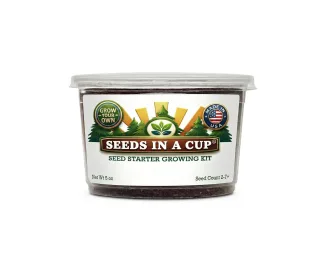
The cup is a temporary germination and seedling stage only. Judas tree transplants poorly, so move the seedling early, with its root ball intact, into a deep pot or its permanent spot, and avoid repeated moves. Sources: c3, c4
06Mature size & space
In US gardens it usually reaches 15-25 ft tall and wide, often with several trunks and a rounded crown. The RHS gives a maximum of 8-12 m (about 26-39 ft) after 20-50 years. NC State suggests allowing 24-60 ft of space. Sources: c3, c4, c5
07Growing conditions
Suited to USDA zones 6-9. Missouri Botanical Garden rates it reliably hardy to zone 6b and suggests a sheltered, south-facing spot in zone 6a. It accepts clay, loam or sand at pH about 6.0-8.0, as long as the soil drains well. Sources: c3, c4
08Weather & tolerances
Once established it tolerates deer, black walnut, drought and dry soil. It does not tolerate wet or poorly drained soil. Sources: c3, c4, c5
09Seasons, flowers & fruit
Rose-purple, pea-like flowers appear in March-April before the leaves, on older wood and sometimes right on the trunk. Flat purple pods 3-4.5 inches long mature in late summer and often hang on into winter. Time to first bloom from seed is not verified for this species; eastern redbud starts flowering 3-4 years from seed, when about 5-6.5 ft (1.5-2 m) tall. Sources: c1, c3, c4
10Other ways to propagate
The species is usually grown from seed; the RHS also lists semi-hardwood cuttings. Redbuds are relatively hard to propagate vegetatively, but that is the only way to reproduce named cultivars such as 'Alba' or 'Bodnant', which are generally budded or grafted. Seedlings will be Judas tree, but they are not reliable copies of any cultivar. Sources: c1, c4, c5
11Pests & plant health
Canker can be serious. Other possible problems are verticillium wilt, dieback, leaf spots, powdery mildew, blights and (per RHS) coral spot. Insect pests include Japanese beetles, treehoppers, leafhoppers, caterpillars, borers, webworms, whiteflies and scale. Sources: c3, c4, c5
12Plant safety
NC State lists the flowers as edible, and the Forest Service manual notes that redbud buds, flowers and pods have been used in salads. Pet toxicity is not verified: it was not found on the ASPCA pages checked. Boiling-water and acid seed treatments are burn hazards. Sources: c1, c4
13Invasiveness & regulations
Not native to the US. NC State says it is not recommended for NC gardens and suggests the native Cercis canadensis instead. US federal and state invasive or noxious listings were not checked (Not verified). Sources: c4
14Garden uses
Used as a specimen or small-group flowering tree for lawns, patios, woodland edges and street planting. Its flowers feed bees and attract butterflies, and birds eat the seeds. Sources: c3, c4
15Native range
Native from southern Europe (France) east to Afghanistan, including Greece, Turkey, Lebanon-Syria and Iran. It is introduced elsewhere in Europe, North Africa and Asia. Sources: c4, c6